
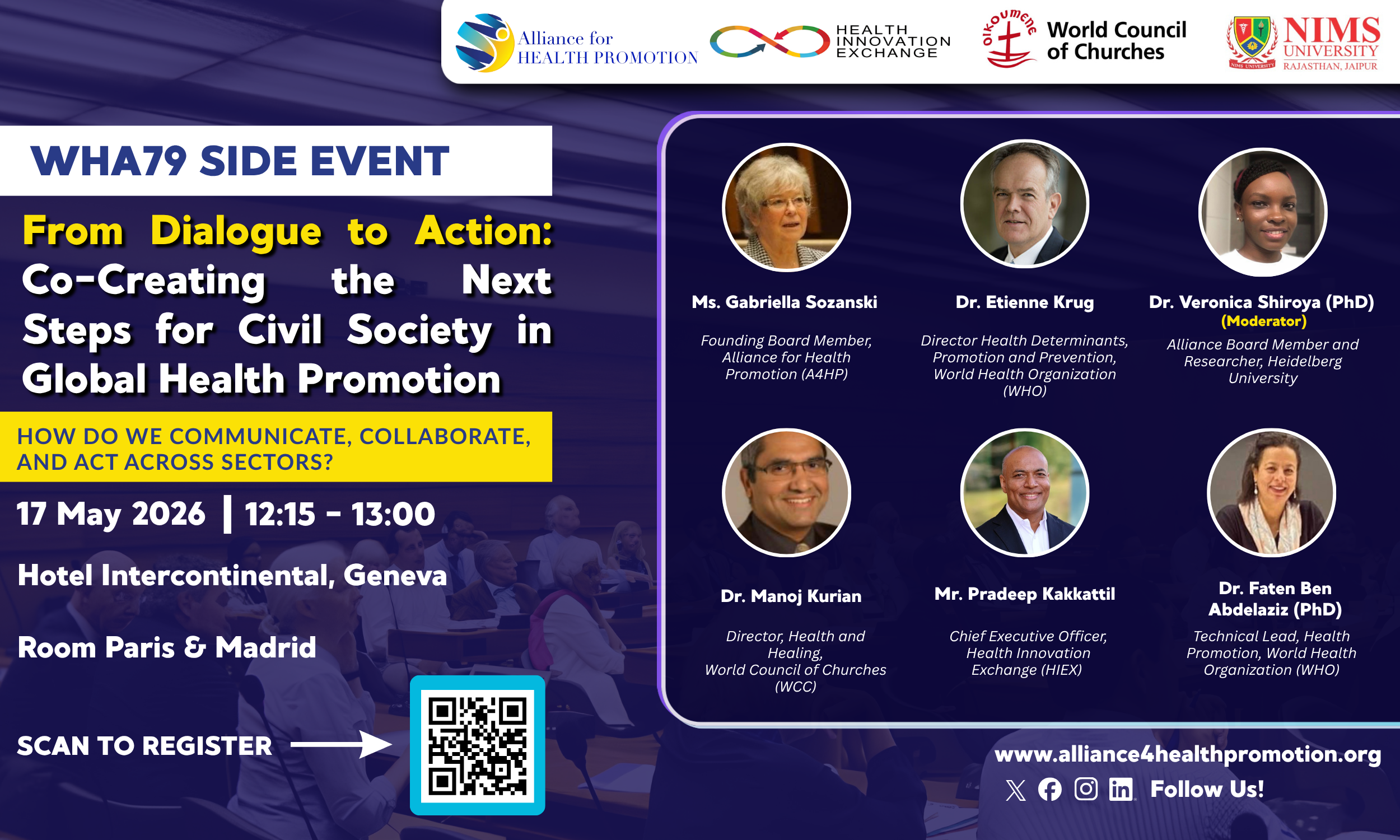
The Alliance for Health Promotion is pleased to co-host a side event during the 79th World Health Assembly titled “From Dialogue to Action: Co-Creating the Next Steps for Civil Society in Global Health Promotion.”
Civil society has long played an important role in advancing health promotion and well-being globally. Through advocacy, community engagement, service delivery, research, and cross-sector collaboration, civil society organizations help translate global commitments into local action while ensuring that health promotion remains people-centered, equitable, and responsive to emerging challenges.
In today’s rapidly changing global environment marked by growing inequalities, complex health crises, political uncertainty, and shifting global priorities, the role of civil society has become more important than ever. At the same time, the field of health promotion is undergoing significant transition. Within WHO’s restructuring process, where the Health Promotion Department has already been abolished, and in the context of ongoing discussions at the Executive Board, including Agenda Item 23 on health promotion and well-being, there is renewed attention to how health promotion is positioned, operationalized, and sustained within the broader global health architecture.
These developments raise important questions about how civil society organizations can work together more effectively to strengthen advocacy, improve coordination, and ensure that health promotion and well-being remain central to global health governance. They also create an opportunity to reflect on how partnerships across sectors including multilateral institutions, academia, faith-based organizations, innovators, governments, and NGOs can move beyond dialogue toward more coordinated and collective action.
The Alliance for Health Promotion (A4HP), as an umbrella organization for NGOs working in health promotion, sees this moment as an important opportunity to:
• Strengthen collaboration and solidarity among civil society organizations working in health promotion and well-being;
• Foster more effective communication and cross-sector engagement among NGOs, multilateral actors, academia, and other partners;
• Explore innovative and collaborative approaches to advancing health promotion within evolving global governance structures;
• Support the positioning of civil society as a strategic partner in shaping the future of health promotion and well-being globally.